Ineris publishes its sixth contract of objectives and performance targets for 2026–2030 – Its ambition: to secure the ecological transition and the renewal of industry

{D9769194-46EF-4373-973F-CE9777716848}.png
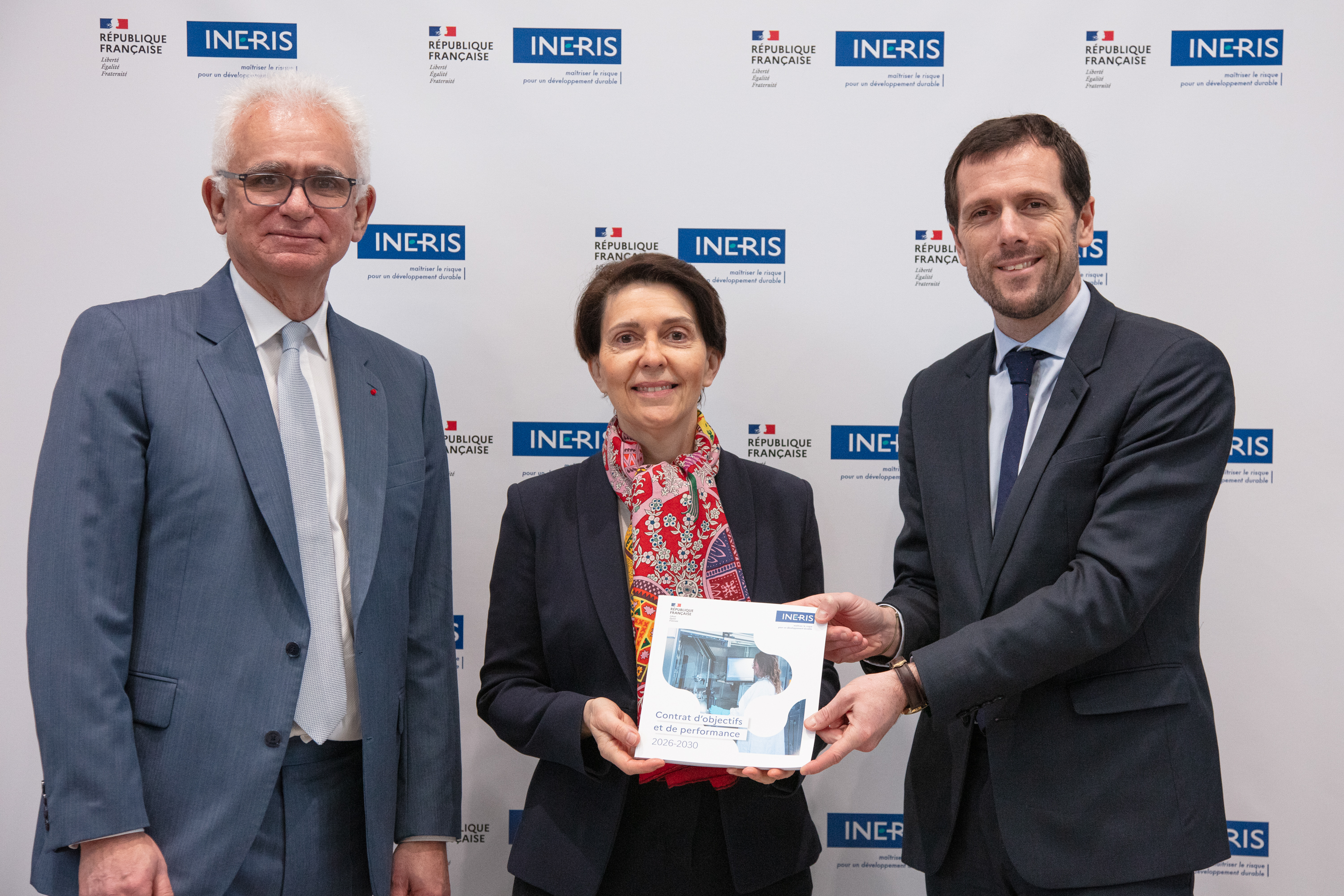
Ineris and the Ministry for Ecological Transition, Biodiversity and International Negotiations on Climate and Nature unveil the Institute's new objectives and performance contract (COP) for the period 2026-2030. Signed on 22 December 2025, this strategic document sets out a roadmap for securing the major challenges of ecological transition and industrial transformation.

The State sets a demanding course for INERIS

The 2026-2030 COP commits INERIS to working alongside the State in a context of rapid industrial, technological and climate change. The rise of new energy sectors, the evolution of the European regulatory framework and the growing expectations of society require public authorities to act with greater efficiency and transparency.

In this changing environment and with 35 years of experience, INERIS must continue to develop its cutting-edge expertise to support the management of technological risks in 13 key areas of activity. To this end, it is mobilising its applied research capabilities, its experimental platforms, which are unique in France, and its advanced digital simulation tools.

Three performance objectives in terms of expertise and research

The 2026-2030 COP sets three performance objectives for INERIS in terms of expertise and research. These are in line with the guidelines set out in its previous contract, following a review of the Institute's missions.

  • Managing the risks associated with the energy transition, the supply of critical raw materials and the circular economy
  • Ineris is committed to stepping up its efforts to support and secure the emerging activities on which the ecological, energy and industrial transitions depend. In particular, the Institute plans to develop its activities in connection with the revival of mineral and subsoil resource exploitation in France.
  • Understanding and managing risks at the level of industrial sites and territories
  • The contract provides for the consolidation of the emergency support unit, which operates 24/7 and is seeing a significant increase in demand, as well as the strengthening of support capacities for post-accident management.
  • Characterising the hazards of substances and their impacts on human health and biodiversity
  • This third objective calls in particular for strengthening synergies between the fields of health and biodiversity and increasing efforts on ‘new approaches’ that promote alternative methods to animal testing. It also provides for strengthening INERIS's action on soil, in addition to its existing action on air and water.

Based on these objectives, the COP is broken down into strategic projects covering all of the Institute's areas of intervention. Each project has milestones and performance indicators that specify the results that the Ministry of Ecological Transition, Biodiversity and International Climate and Nature Negotiations expects from the Institute.

Transformation projects structured around efficiency, dialogue and social responsibility, and digital technology

The Institute's economic model is based on a three-pronged approach combining support for public policy, applied research and services to businesses. The COP 2026-2030 reaffirms the relevance of this model.

At the same time, the State is asking INERIS to continue structuring its policy of dialogue, sustainability and social responsibility and is setting ambitious 5-year targets, such as a 50% reduction in its greenhouse gas emissions linked to energy consumption (compared to 2022).

The contract is accompanied by a €32 million investment plan to finance the transformation of INERIS's experimental facilities and its digital acceleration project, which includes the completion of laboratory digitisation, the enhancement of digital prediction simulators and the increased development of artificial intelligence applications.